









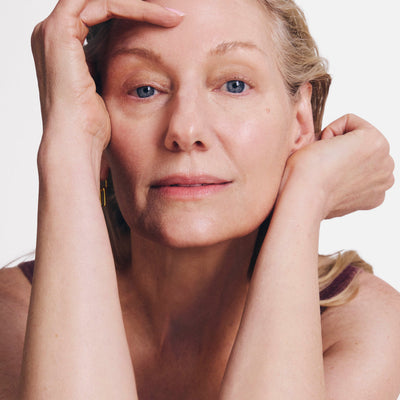



If you’ve ever spied a sort-of-but-not-quite freckle that seems to have miraculously appeared out of nowhere on your skin—congratulations! You’ve likely experienced an age spot.
Rest assured: They’re very common and very manageable with the right skincare in your corner.
First Of All: What Is An Age Spot?
Age spots are small, flat, brown patches that appear on the skin across the face, chest, shoulders, and hands. You might be more familiar with some of their alter-egos, including: sun spots, liver spots, or solar lentigines (that’s the science-y name).
As a type of hyperpigmentation, age spots happen when an area of skin has produced more pigment (melanin) than usual. They can happen to anyone, at any age—but they’re particularly more pertinent after the age of 50.
Why Do Age Spots Happen?
Short answer: The sun.
Every time your skin is exposed to UV light, it produces melanin to protect itself. Over years (and decades), pigment production can cluster in certain areas. That’s when age spots appear.
While it feels like they just show up at random, age spots don’t appear overnight. They’re a slow take shape beneath your skin’s surface, accumulating over time through sun exposure.
Why Are Age Spots More Common On Mature Skin?
Technically, age spots and other types of hyperpigmentation can happen at any age, to anyone.
But since they are caused by a slow build up of melanin, they’re going to be more common in skin that’s had more time to accumulate it. IE. not skin that errs on the side of tween.
Skincare For Age Spots
First things first—as with any new bouts of hyperpigmentation/spots/ new dark marks you notice on your skin—check in with your doctor and complete a skin check. ASAP.
In terms of skincare side of things, you’re going to want to reach for skincare with these ingredients:
Vitamin A
This potent skin ingredient targets age spots in two ways. First, vitamin A speeds up skin cell renewal to help remove pigmented surface cells more quickly and replace them with newer, more evenly toned skin. Over time, this process can help fade the appearance of age spots and improve skin clarity.
Second: It regulates how much melanin your skin produces and how it’s distributed. It calms overactive pigment cells, reducing excess melanin in concentrated areas. This helps prevent dark spots from forming and supports a more even, balanced skin tone over time.
Vitamin C
Brightening ingredient vitamin C helps fade age spots by inhibiting the enzyme responsible for melanin production. This reduces excess pigment formation and gradually brightens dark areas. Plus, as an antioxidant, this ingredient also protects against UV damage, helping prevent new spots from forming while improving overall skin radiance.
Glycolic Acid (AHA)
This one works by exfoliating the skin’s surface to loosen and remove some of the dead, pigmented cells in the process. AHA helps reduce the intensity of existing dark spots and reveal fresher, more evenly toned skin underneath.
Sun Protection
Non-negotiable. Daily SPF helps prevent and improve the look of age spots. Without daily sun protection, UV rays will keep stimulating those pigmented cells to make existing dark spots look even darker and triggering new ones. Plus! Since ingredients like AHAs and vitamin A make your skin more sensitive to sun damage—consider SPF the most important step of any age-spot-targeting skincare routine.

Comments